Phase 0 report
Date: 2026-09-21
Status: complete, and since superseded in one respect — the image now ships
wine-sg rather than Debian's Wine, so 32-bit Windows applications run.
See ADR 0005. The report below is
otherwise as written at the end of Phase 0; the WoW64 section's conclusion
("the answer is no") was true of packaged Wine and is what led to building
our own.
The brief asks for a report at the end of Phase 0 covering what worked, the X11-vs-Wayland finding, the Wine build choice, and the multi-user debt list.
The target, and whether we hit it
A Debian image that boots in QEMU straight into Wine's
explorer /desktopas the shell, from a system-level prefix.Done when: fresh clone →
make image && make boot-testpasses locally and in CI, and the screenshot shows a taskbar with a running app.
Hit, both locally and in CI, from a fresh clone.
[boot-test] ssh is up after 15s
[boot-test] running sg-session-check in the guest
info  session.env found after 0s (display=:0 path=x11)
PASS  wineserver is running
PASS  explorer.exe is running as the shell desktop
PASS  desktop window exists: "shell - Wine Desktop"  1280x800+0+0
PASS  taskbar present: ("explorer.exe")  1280x20+0+780
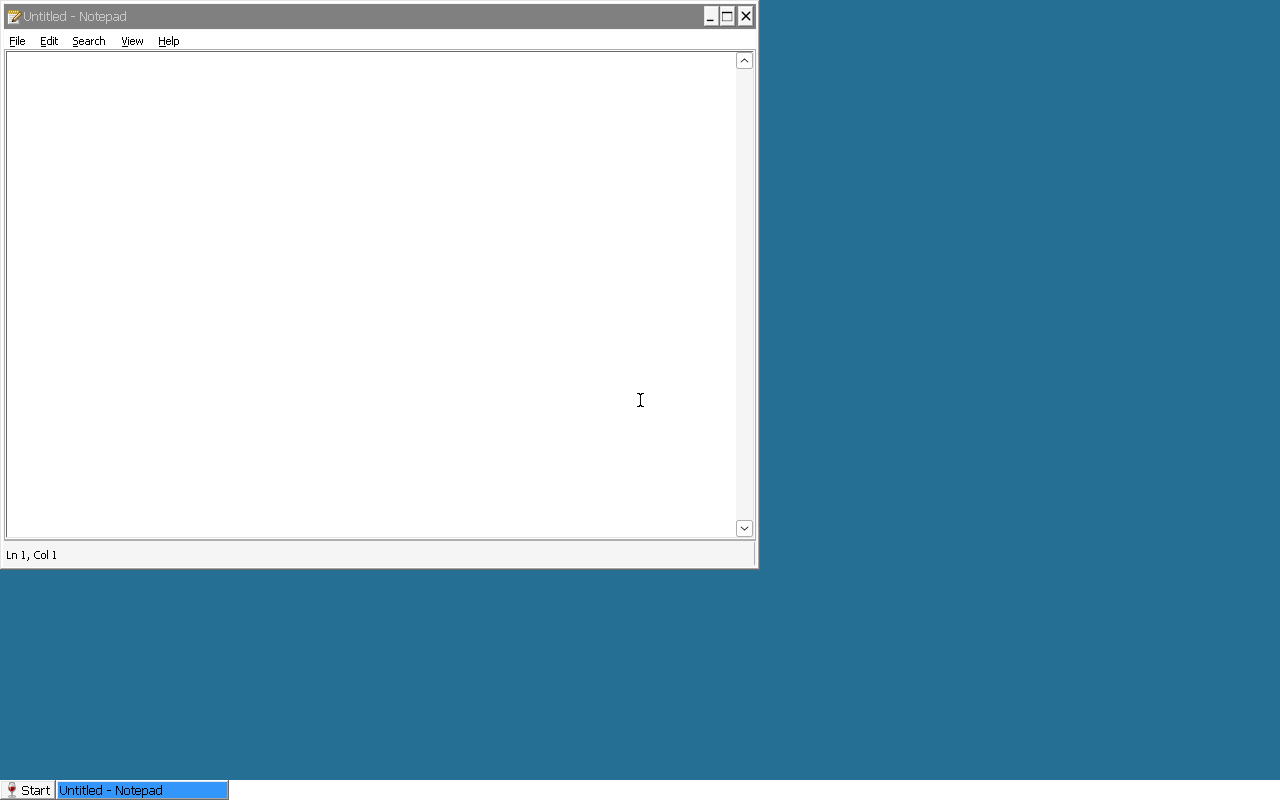
PASS  notepad is inside the desktop: "Untitled - Notepad"  760x570+0+0
PASS  notepad.exe process is alive
RESULT: PASS
[boot-test] GATE PASS
CI runs the same gate on a GitHub runner with no /dev/kvm, under TCG, and
passes in about six minutes:
No KVM: the gate will run under TCG (slow)
[boot-test] ssh is up after 68s
PASS  wineserver is running
PASS  explorer.exe is running as the shell desktop
PASS  desktop window exists: "shell - Wine Desktop"  1280x800+0+0
PASS  taskbar present: ("explorer.exe")  1280x20+0+780
PASS  notepad is inside the desktop: "Untitled - Notepad"
PASS  notepad.exe process is alive
RESULT: PASS
[boot-test] GATE PASS
And the screenshot shows a Start button, a taskbar, and Untitled - Notepad
running in it:
X11 vs Wayland
X11 wins for Phase 0. Full reasoning and evidence in ADR 0003.
Both paths were run headlessly, not reasoned about. winewayland is not
broken — explorer and notepad both start and stay alive under it. It loses on
two specific counts:
- No virtual desktop.
/desktop=shell,WxHis awinex11feature. Underwinewaylandthere is no desktop surface, so there is no taskbar — which is the exact thing Phase 0's "done when" asks for. - Nothing can enumerate the windows. cage implements no
wlr-foreign-toplevel-management. The gate's requirement that an app "appears in the window list" is not merely failing under Wayland, it is unobservable.
Point 2 is what settles it. A gate that cannot see the thing it is gating is not
a gate. Under X11, XWayland makes xwininfo -root -children a complete answer.
Revisit at P8, when sg-compositor replaces cage. A compositor we write can
implement toplevel enumeration and host per-window surfaces, which removes both
objections at once.
The part of this that was nearly missed
Wine prefers winewayland whenever a Wayland socket is present, and cage always
provides one. Without an explicit HKCU\Software\Wine\Drivers\Graphics = x11
in the prefix, the "X11 path" silently becomes the Wayland path.
Worse, and found only by looking at the screenshot: the gate initially passed
while showing no taskbar at all. wine notepad was opening its own X
toplevel outside the Wine desktop, and under a fullscreen compositor that
toplevel covered the desktop completely. The check was asking "does a window
named Notepad exist somewhere", which was true and meaningless.
The fix is HKCU\Software\Wine\Explorer\Desktop = shell, which makes the
virtual desktop the default for every process in the prefix. The gate now
locates the desktop's X window, requires a taskbar among its children, and
requires notepad to appear inside it.
Wine build choice
Debian's wine 10.0 (10.0~repack-6), not WineHQ's 11.18. Full reasoning in
ADR 0001.
Nothing in Phase 0 needs anything newer, and Debian's package means the image builds from a single trusted origin with no third-party apt source or key. WineHQ was not rejected on a failure — it simply costs more than Phase 0 needs, which is worth stating so it gets reconsidered on its merits at Phase 1.
Revisit trigger: the first time we need a fix newer than 10.0, or the start of S2, whichever comes first. S2 will very likely require building Wine ourselves, at which point the question stops being "which package".
WoW64: the answer is no, and it matters
The brief asked us to evaluate Wine's new WoW64 mode to keep the image pure amd64. We did. No packaged Wine is built for it. Full evidence in ADR 0002.
Both Debian and WineHQ ship the WoW64 thunk DLLs in their amd64 packages, which looks like a dual-arch build and is not — the i386 PE set lives only in the separate i386 package:
$ dpkg -L libwine:amd64 | grep -c '/wine/x86_64-windows/'   # 750
$ dpkg -L libwine:amd64 | grep -c '/wine/i386-windows/'     # 0

$ dpkg-deb -c wine-devel-amd64_11.18~trixie-1_amd64.deb \
    | grep -oE '/wine/[a-z0-9_]+-(windows|unix)/' | sort | uniq -c
    287 /wine/x86_64-unix/
   1008 /wine/x86_64-windows/        # no i386-windows tree
wine-devel-amd64 also declares no i386 dependencies, so it installs cleanly on
a pure amd64 system and then cannot run 32-bit Windows binaries. That is a trap
worth knowing about.
So the Phase 0 image runs 64-bit Windows applications only. For a Windows replacement aimed at real fleets that is a serious limitation, acceptable only because Phase 0 is a bring-up target.
This needs David's decision — tracked as
#4. The options are
i386 multiarch (cheap, permanently doubles the image's library surface) or
building Wine with --enable-archs=i386,x86_64 (more work, keeps the image
pure, probably needed for S2 anyway). Recommendation: the latter. S3 is
likely to force the issue, since scanner drivers and TWAIN data sources are
frequently 32-bit.
Multi-user debt
docs/multiuser-debt.md — eleven items, D1–D11, each
tagged with a MULTIUSER-DEBT: D<n> comment at the place in the code that
incurs it, and each mapped to the clause of the S2 gate it retires.
The list is not complete. S2 will find more. It is complete as to what Phase 0 actually did.
D5 is the one that matters most. The wineserver's lifetime is currently a
login session: it is started by the session, as the session user, and dies with
it. Windows services run as SYSTEM before any login and survive every logout. A
wineserver scoped to a login session cannot express that.
Whether a machine-level wineserver is reachable by patching Wine's process model rather than rewriting it is exactly the question S2 exists to answer, and the one that decides patch-set vs. permanent hard fork.
What went wrong, and what it cost
Recorded because the failures are more informative than the successes, and because every one of them is a thing the next person would otherwise rediscover.
| Symptom | Cause | Where it is now written down |
|---|---|---|
| Boot hung forever, serial log just stopped at 6s | systemd-firstboot ran its interactive wizard: "Please configure your system! — Press any key to proceed" |
systemd.firstboot=off in mkosi.conf, and sg-image/CLAUDE.md |
systemctl enable greetd.service → "Unit does not exist", though greetd was installed |
The postinst ran in mkosi's sandbox, where /usr is the host's |
renamed to mkosi.postinst.chroot; the extension is the fix |
greetd crash-looped at pam_start: ABORT |
/etc/pam.d/greetd @includes login, and the login package was not installed |
login and libpam-systemd added to the package list, with a comment saying why |
Wine prefix build failed with No space left on device |
mkosi's default Minimize=guess sizes root to exactly fit its contents |
mkosi.repart/10-root.conf, SizeMinBytes=8G |
sg-session package install: adduser → chown: Invalid argument |
Image builders run in an unprivileged user namespace, where chowning to another uid is not permitted | --no-create-home, with the directories created by tmpfiles.d at boot |
Unable to locate package sg-session, intermittently |
mkosi's PackageDirectories only regenerates its apt repo when the repo dir's mtime changes; a .deb copied over an existing file does not move it |
install from an extra tree with dpkg instead; reasoning recorded in mkosi.conf |
| Gate passed with no taskbar on screen | The check only asked whether a window named Notepad existed anywhere | virtual desktop made the prefix default; gate now checks the taskbar and in-desktop placement |
| Gate passed locally, failed in CI with the desktop plainly in the window list | Wine titles the window Wine Desktop on Debian and Wine desktop on Ubuntu; the match was case-sensitive |
matched case-insensitively, and sg-session's CI now runs in a trixie container |
Fresh clone: QEMU refused to start, UNIX socket path is too long |
The QMP socket lived under build/, and a UNIX socket path cannot exceed 108 bytes |
socket moved to a short temp directory |
The last row is the one worth dwelling on: a green gate that was not measuring the right thing. The screenshot is what caught it — the serial log and the exit code both said everything was fine. That is an argument for keeping the screenshot artifact unconditional, which the gate now does.
Deviations from the brief
Each of these is a deliberate call, not an oversight.
- No backports kernel or Mesa. The brief asks for them. The gate runs
against QEMU's virtio-gpu, which trixie's Mesa drives fine, so backports
would add a second apt suite — and a second source of churn in the one thing
that must stay reliable — for no Phase 0 benefit. They earn their place when
the image meets real hardware. See
sg-image/docs/packages.md. - VKD3D-Proton is not in the image. It is not packaged in Debian at all.
Debian's
vkd3dpackages are Wine's own vkd3d, a different project, and not a substitute. DXVK is packaged and is installed. Tracked as #6. - No
debian/insg-image. The artifact there is a disk image, not a package.sg-sessioncarriesdebian/and builds a.debin CI, as the rule intends. - The Wine prefix is built on first boot, not baked into the image. The
image build's
/varis not the image's/var, so a prefix written at build time is liable to be discarded — and a "baked" prefix that silently is not there is worse than no bake at all.
What CI caught that local testing could not
Three of the rows above came only from running elsewhere, and are worth separating out, because they are the argument for having CI at all rather than declaring victory on a developer machine:
- The case-sensitive window title match. It passed on Debian and failed on Ubuntu against a window list that visibly contained the desktop.
- The fresh-clone socket path. Only a deep checkout directory reveals it.
- Every host tool
mkosishells out to —bootctl,mcopy, and the ability to create a user namespace at all. A developer machine has these incidentally; a clean runner does not, and each one failed in turn.
sg-session's gate now runs in a debian:trixie container rather than on the
Ubuntu runner. That is not tidiness: Ubuntu's Wine and Debian's differ in ways
that reached the gate, and sg-image builds a trixie image, so the container
tests what we actually ship to.
Open items
- The
waylanddisplay path is kept as a supported setting so the ADR 0003 comparison can be re-run cheaply, butsg-session-checkfails loudly rather than silently skipping when pointed at it. - Minor rendering artifact at the top of the boot-gate screenshot — a few stray bars over Notepad's title bar area. Almost certainly a software-rendering repaint artifact in the virtio-vga framebuffer capture rather than anything in Wine. Not investigated; noted so it is not mistaken for a new bug later.
Waiting on David
| #4 | 32-bit support: i386 multiarch vs. building Wine with --enable-archs. Recommendation: build Wine. |
| #5 | Confirm LGPL-2.1+ for sg-image and sg-session (shipped on the brief's default) |
| #6 | How to source VKD3D-Proton, or defer it |
| #1 #2 #3 | Confirmation to start Phase 1. Per the brief, no Phase 1 repos are created until you say so. |